Showing posts with label photography. Show all posts

Thursday, July 7, 2011

Back Again..

It's been a while since the last post. But then, I was on a holiday....

 It was almost a five year plan.  The visit to the UK to see the elder one and S-I-L.

The visa application had been downloaded so many times in the past.  Filled in too.  And just kept aside. I think the elder one did not take us seriously this year either.  Especially when we had not submitted the papers and hardly a month left before our scheduled date of departure.  She threatened to cancel her leave.

And when it finally did happen, it was one major rush.  The passport with the visa arrived a week prior. The scramble for tickets. The volcanic ash almost playing spoilsport. The on and off  airline strike.  And then, suddenly, it happened. The whole family together after a very long time.

 We were given a day to rest and then we were off to the countryside.  Initially the camera had not a moment of rest.  Until it appeared that every scene had to be captured.  But how many?

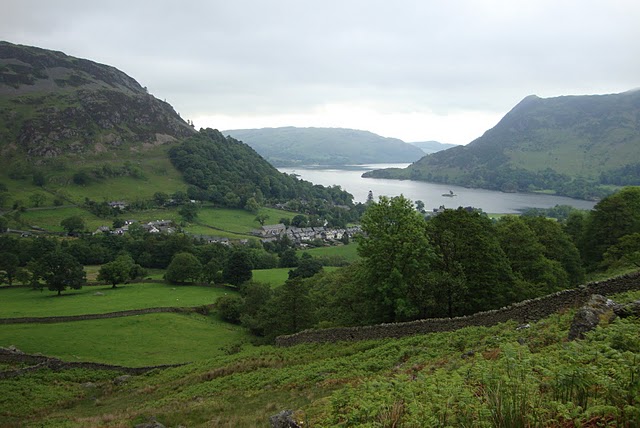
A trip to Lake District, and we realise how Wordsworth, who lived here, might have been inspired. The poetry could have been spontaneous. But while he did pen down his words, I was only left speechless. The scenery  so breathtaking.


While we were sad it ended, we were also glad to get back to the routine, however mundane it might be.  I guess that is what keeps one going.

Groan, groan, another boring day...... another menu to think of ...getting ready to work.... until the next holiday.

Saturday, July 3, 2010

Life Rocks?

This is a temporary slum that shelters construction workers.  These workers have just finished constructing the five star Park Hotel that is a stone's throw away from their dwellings.


To waterproof their homes they use flex, vinyl material that is discarded.  It is ironical that one of them has a flex that proclaims 'Life Rocks'. 

Tuesday, February 9, 2010

Jer Mahal - Glimpses of Mumbai - Part - II


I took this picture as we were driving past (so I just got this portion ) because it really looked quaint and reminded me of the old Bombay.  It was only later when I had downloaded the images and examined them a little closely that I saw the only board that I could make out - Kashmir Hotel - which I googled, more to find out the locality and a little more about the place.  Imagine my surprise when I identified it as Jer Mahal, classified as a Grade III structure under the Heritage Rules in Mumbai. 

Jer Mahal is a chawl system of (five) buildings, around 120 years old, built with the sole purpose of providing cheap accommodation to those who came to work in Mumbai.  Located along Girgaum Street on one side and Kalbadevi on the other it showcases both the Indian vernacular and the European style of architecture.   Heritage III buildings are considered to be of importance to the townscape and add to the character of a locality. The façade of the building also cannot be tampered with.

The site - http://theheritagekids.org/ hopes to involve the young to preserve the heritage.  The organisation believes that  there  is a great possibility that every old building you see anywhere has a story to tell. There is so much in our arts, crafts, structures, monuments that they feel that we can learn from this heritage to build on our future.

They plan  to identify architecture units / sites and monuments.  After their research of the site, clean up pictures and show how the place can be revived and preserved.  It hopes to appeal to the occupants of these buildings, and approach corporate houses and organisations to help them in their endeavour.

Their plans for the Jer Mahal is to look like this - 
They believe that the building and the surroundings can be cleaned and the architectural beauty be restored.

It would be no easy task. BMC permission, legal help in relocating the tenants, architectural help for restoring the structure and of course funds.

The BMC permission would probably be the toughest hurdle.  Around two years ago, the Mumbai Metropolitan Region Development Authority prepared a fresh list of heritage structures in the city. According to the revised lists, Jer Mahal is to be re-designated as a Grade-II structure. The revised list has been submitted to the government for notification. The notification is yet to see the light. And by not doing so, the government according to Conservation architect Abha Narain Lambah is giving a signal to developers to destroy heritage buildings. Moving the building to Grade-II, could be the only way to save the Jer Mahal.

I hope the conservationists have their way.  The building caught my eye in the otherwise crowded area. With most old buildings giving way to ugly, unplanned concrete structures, the city is fast losing its charm.

I really do hope to see the Jer Mahal in my future visits to the city.

Monday, February 1, 2010

Haji Ali Dargah - Glimpses of Mumbai Part I

Haji Ali is a mosque and a dargah, constructed in 1431, and is located on an islet off the coast in Mumbai.  I had gone to attend a nephew's marriage and was lucky to have stayed where I had a good view of the dargah. 

The day was clear except for a slight mist ( or was it pollution - since it was almost past 10 in the morning). 


This was as the sun was setting and the water was receding too.

 And there were patterns on the shore as the water receded and the reflection of the setting sun made a beautiful sight.


I did want to visit the shrine but could not for lack of time and company.  But then I did have my fill of the beautiful scene.

Thursday, January 14, 2010

Flying High

Sankranti the harvest festival is a favourite of mine.  And largely because of kite flying.  I was an expert at it.  And to my surprise a couple of years ago, found that the skill was intact.

This year, weather was quite a dampner to the festivities.  Rain, incessant drizzle and cloudy skies coupled with exorbitant costs, must have prevented people from buying kites.  I found fewer kites in the sky. 

It is believed that kites were brought to India by the Chinese travelers - Fa Hien and Hiuen Tsang.  Indian kites are called the fighter kites - simple paper and bamboo - with special thread called manja, that is sharp and used for fighting with other kites.  We made it at home many years ago - with a mixture of plant sap, ground glass and colour - that would be applied on ordinary thread to give it that 'cutting edge'.

There is a story about kite flying in ancient India. The rulers or the nawabs of Lucknow used to fly their kites from their palace rooftops with a small purse of gold or silver attached as an incentive for the others to try cutting down the kite to retrieve the precious contents. It is also rumoured that the nawabs were not one to give away their money so easily and so they would have their own men out in the street to ensure that they got their kite back, with the purse intact. 

As a youngster, it seems so cruel now, that there were times that I chased a couple of birds by taking a deep dive with my kite, swooping down on the unsuspecting creatures and frightening them out of their wits.


It could have been because of kites that were stuck in trees that we had unusual bird activity in our area.  Birds that were disturbed from their usual habitat were flying around, and I got to see many of them today.


and this one

and this bluebird


If anyone can identify these birds for me, I would appreciate that.

And for a birds eye view of the ground below, is Nicolas Chorier, a Frenchman who specialises in "kite photography".


Chorier makes 40-sq-foot kites from siliconised nylon and carbon or fibreglass rods. The camera sits in a cradle on a line beneath the kite. The camera cradle operates by remote control . Kite and camera are flown to the required height. Chorier carries the remote control on his shoulder and the video monitor around his neck. He walks and raises and lowers the kite for shooting angles.  He has taken some amazing pictures in India and brought out a book Kite's Eye View: India Between Earth and Sky.
 Jama Masjid -

and the Jodhpur fort


And yes, he did lose a camera, dropping it in the Yamuna river behind the Taj Mahal. It is quite a technique to take pictures with a remote control. But, I am sure the most difficult task  of the whole exercise would have been to get permission from the Indian government to take these pictures, considering the fact, that at ground level at most tourist spots, photography is either prohibited or at an additional cost.

Well, inclement weather it may have been for kite flying today, but not for the other festivites that are part of Sankranti.  The rangolis were there and so were the sweets.  And I hope the harvest is bountiful and the food prices come down as quickly as they shot up.

Wednesday, December 30, 2009

'Crafty' Animals

Ever since prehistoric days, man has always depicted animals in his drawings -


And now through his craft . 

Handcrafted in Kashmir, this quaint tea cozy is embroidered with wool fibers. Legend is that the first cozy was crafted of wool by a farmer's wife. When coming in from work, her husband threw his woolen cap on the table and it landed on the teapot. Much to their surprise, the cap kept the tea steaming hot for some time. 


Leather craft from Nimmalakunta, a village from Andhra Pradesh.  The craft of making leather puppets or Tolu Bommalu, which they practice, is quite an old craft.  Because of low demand for the puppets, most of craftsmen have shifted to making lampshades and other decorative artefacts.

Gujarat applique is mainly based on patchwork , has a distinctive style of its own.  Coloured and patterned fabric is finely cut in different sizes and shapes and sewn together on a plain background . The stitches in gaudy colours are not hidden and add to the beauty of the patchwork.


And the wooden animal figurines with brass inlay work.

And Madhubani paintings from Bihar. Cotton is wrapped around a bamboo stick to serve as a brush, which is dipped in colors and applied on to the fabric. The outline is done with double lines. No shading is done. The gaps between the two lines are filled with cross or straight lines.

Wrought iron figures - Bastar Tribal arts               

Papier-Mache figures
Only a few ..... the list is endless.
Pictures taken at Dili Haat, Delhi and Shilparamam, Hyderabad.

HAPPY NEW YEAR

Thursday, December 10, 2009

Imagine All the People Living Life in Peace – The Bahá’í Temple

Was John Lennon inspired by the Bahá’í Faith when he penned the lyrics of the song ‘Imagine’. He and the Prophet founder of the faith Bahá’u’lláh, who said “The earth is but one country and mankind its citizens,” seem to have a lot in common.


I was in Delhi for a short visit and made a visit to the Bahá'í Mashriqu'l-Adhkar, better known as the "Lotus Temple" ( Kamal Mandir as the auto drivers of Delhi know it). As you approach the temple, one gets the first glimpse as the road takes a curve, and you gasp. Then it goes out of sight till you are almost there.

As you walk into their premises, every step, seems to be the ideal photo op. Cameras, mobile phones all work overtime. People who may otherwise be camera shy request you to take their picture with the temple in the background.


Constructed to resemble a lotus flower, the temple made of marble, cement, dolomite and sand stands on 26 acres of land, . The Persian architect Fariborz Sahba from Canada, created the beautiful structure composed of 27 free-standing marble clad "petals" arranged in clusters of three to form nine sides. Nine pools encompass the building and nine doors open on to a central hall.

The structure is slightly more than 40 metres tall and it took 800 engineers, technicians, workers and artisans almost ten years to complete the task. At a lecture at Yale, the architecht is reported to have said that the temple was built with primitive methods, but the dedication of the workers more than made up for the lack of technology available at that time. The doors of the temple were thrown open to the public in December 1986


As we approach the temple, we are requested to remove our footwear and maintain silence within the main inner hall. Volunteers of different nationalities guide the tourists. ‘You may sit as long as you wish. You may belong to any religion, but you are free to pray ’ . Photography is not permitted inside and therefore one could not capture the beautifully structured dome. No idols, no noise, no bells, no chants. It is so peaceful and the silence unconsciously nudges you into closing your eyes in prayer. What is more amazing is that the average Indian known for his noisy demeanour is silent without being monitored. Such is the effect of the magnificent structure .

The building uses natural light that streams through the inner folds of the petals of the temple, and the construction is based on the Mughal ventilation technique and has an amazing inflow of fresh air and therefore banishes the need for an AC – that is conspicuous by its absence.

As we walk out, we are asked if we have the time to visit the museum at the other end which houses literature of the faith and pictures of the Bahá’í places of worship in other parts of the world. It is worth a quick visit, and if you have more time, view the video that shows the construction of the temple at different stages.

I did not feel the need to be a Bahá’í to appreciate their ideology. I guess all peace loving individuals feel that way. I wish all places of worship were like the Bahá'í Mashriqu'l-Adhkar temple – clean surroundings, peaceful and quiet – conducive to meditation and prayer.

You may say that I'm a dreamer
But I'm not the only one
I hope someday you'll join us
And the world will be as one

Wednesday, August 19, 2009

Chowmahalla Palace

It was like rediscovering my city as I took my brother and his family around the various touristy sites. I had heard that the Chowmahalla Palace was open to public , but then this was a place that had gone unnoticed the many times I had gone past it on the way to a friend's place in the old city. Of course, one had no inkling of what lay beyond the tall walls of the palace.

Rather reluctantly and hoping not to be disappointed we made our way to the Palace. And what we saw was amazing.

The Chowmahalla Palace, built over 200 years ago was the seat of the Asaf Jahi dynasty where the Nizams entertained their official guests and royal visitors. Chowmahalla as the name indicates comprises of four palaces and is supposedly a replica of the Shah of Iran's palace in Teheran. Of the 45 acres on which the Palace was originally built, only 12 acres remain.


The Shishe-Alat ,which was once used as guest rooms for officials accompanying visiting dignitaries . 'Shishe' meaning mirror image of the Bara Imam - a long corridor of rooms on the east side that housed the administrative wing .

The Khilwat, the grand Durbar Hall with a distinct Persian influence . The beautiful belgian chandeliers take your breath away. The hall has a pure marble platform on which the Takht-e-Nishan or the royal seat was laid

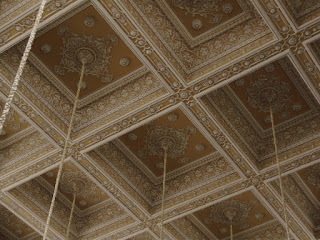
The ornate ceiling:

The clock above the main gate to Chowmahalla Palace is the Khilwat Clock. It has been kept ticking away mainly due to the efforts of a family of clock repairers that wind the mechanical clock every week .


The lovely windows from the exterior.


A view through the window

The Mehtab Mahal

I seem to have got carried away. And these are just few of the pictures that were taken. One could spend the whole day just admiring the architecture, the carved furniture, the lovely chandeliers, the vintage cars, and all that is synonymous with royalty.

The castles of Scotland can wait a while, let me first discover the beautiful palaces in my neighbourhood.

Saturday, August 8, 2009

The Magnificent Golconda Fort


I love forts. I may not dwell too much into their history, but am amazed by the engineering skills of the ancient times, all without mechanical aids that are used in modern day construction. And to think they have withstood battles, foreign invasions and natural calamities are a marvel.

The ardous climb

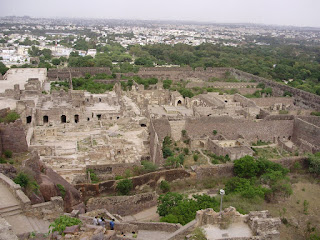
View from the top

The fort wall

The Golconda fort was built in the 13th century. The perimeter of the fort is about 7 miles. It has 87 semi circular bastions. Like most forts in India, it a huge gate which has sharp iron knobs to protect from attack of elephants. The center porch was acoustically designed, and the sounds from here could be heard at the centre point at the top of the fort, and the arrival of any visitor would be immediately conveyed in this manner. The fort houses arms depot, the baths, barracks, watering canals, the stables and reservoirs ( these were constructed at different levels and the irrigation systems at the fort were considered extremely superior). The general assembly or the Balahisar is located at the summit of the fort, which is 400 ft above the sea level.

The fort is invariably on the itinerary of any visitor to our city. But with bad roads and terrible traffic, the thought of visiting the fort is a nightmare. To avoid these hardships, guests would be generally put on the sight-seeing bus . But when my brother who was here on a holiday from the U S of A with his family expressed a desire to see the fort, I decided to take them there. And it was well worth the effort, as always.
The path to the fort has encroachments, in fact, the shops and houses led almost to the entrance of the fort, and a golf course that is coming in the vicinity is a major threat to the lovely structure. One must compliment the archaeological department for keeping the place 'fairly' clean. And to allow cameras to be taken in without a fee.
However, signs like this cause some amusement.

And one wonders if this signboard (below),considering the condition of the board, is as ancient as the fort itself.
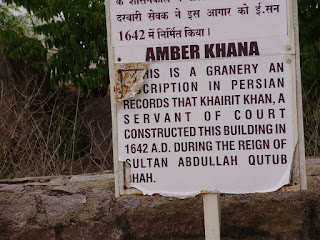
One would wish there were more descriptions of the various structures and direction boards to help you along. But these cannot detract from the magnificence of the structure.

If only the locals would appreciate the beauty of the monument and help preserve the site, our city would truly have come a long way.


Check out this link - http://www.wanderingeducators.com/best/traveling/carnival-cities-september-9-2009.html
- my post on Golconda Fort was accepted for the Carnival of Cities.
Related Posts with Thumbnails